Let’s be honest: there is nothing quite as jarring as that 7:00 AM weekday wakeup call, dragging yourself into the bathroom, flicking a switch, and being greeted by the harsh, clinical glare of four recessed overhead spotlights. It feels less like starting your day and more like being prepped for an emergency appendectomy. If your bathroom looks like a high-security detention centre under the glare of overly blue, high-Kelvin downlights, you aren’t alone. For eleven years, I’ve been telling homeowners the same thing: light the face, not the ceiling.
The "operating theatre" aesthetic is the death of luxury. If you are tired of harsh shadows under your eyes and that cold, blue tint that makes your complexion look like you’ve been living in a cave for three years, it’s time to rethink your bathroom lighting strategy. We’re moving toward a model of wellness and hotel-inspired residential design, where the bathroom acts as a transition space—a place to wake up slowly or wind down properly.
Why Overhead Lighting Fails Your Daily Ritual
Most bathrooms in the UK are built with a "scattergun" approach to lighting. A couple of IP65-rated downlights are thrown into the ceiling, and the electrician calls it a day. The problem? Physics. Light coming from directly above creates deep, unforgiving shadows in your eye sockets, under your nose, and beneath your chin.
When you’re trying to shave or apply makeup at 7:00 AM on a Tuesday, these shadows are your enemy. You end up leaning closer to the mirror, further obstructing the light source, and making the problem worse. Furthermore, standard overhead lighting usually relies on "cool white" bulbs (4000K+). This overly blue light suppresses melatonin and adds a sickly pallor to the skin. You don't need a searchlight; you need ambient bathroom lighting that works with you, not against you.
The Gold Standard: Mirror Integrated Lighting
The smartest upgrade you can make in a bathroom refit is moving the light source from the ceiling to the mirror. Mirror integrated lighting is the cornerstone of the modern "spa-at-home" movement. By placing the light source directly at eye level, you eliminate the shadows created by overhead lights.
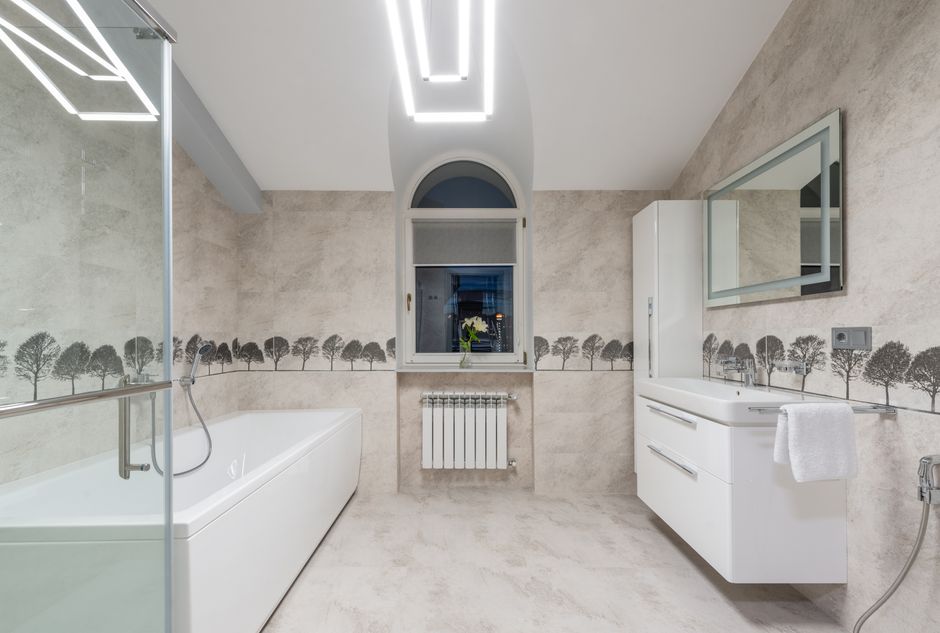
When shopping for these, look for high Color Rendering Index (CRI) values—ideally 90 or above. This ensures the colours you see in the mirror are accurate to how you’ll look in natural daylight. If your mirror is the only thing lighting your face, ensure the diffusion is excellent. A "hot spot" of bright LEDs piercing through cheap frosted glass is just as bad as a cheap spotlight.
Alternative Ambient Bathroom Lighting Options
If you aren't ready to go all-in on a high-tech mirror, or if you have a vanity setup that requires more coverage, you need to layer your light. Here are the most effective alternatives:
- Wall Sconces: Mounting two sconces at eye level on either side of the mirror provides even, cross-directional light. It is the gold standard for makeup artists for a reason. Recessed Wall Channels: Using LED tape housed in IP-rated aluminium profiles recessed into the wall or around a vanity edge provides a soft, "glow" effect that is much easier on the eyes during a midnight bathroom run. Under-Cabinet Lighting: If you have a floating vanity, hidden LED strips underneath can illuminate the floor, creating a soft, ambient secondary light source that doesn't trigger that "wide-awake" cortisol spike first thing in the morning.
The "Smart" Bathroom Wave: Be Careful Where You Step
We are currently in a wave of "Smart Home" integration. Every manufacturer now wants to sell you a mirror with a built-in touchscreen, Bluetooth speakers, and a companion app. Before you empty your wallet, take a breath. I’ve seen enough abandoned renovation projects to know when a feature is just another app you will forget exists by the second week.
Do you really need to control your mirror’s brightness via your phone? Probably not. A simple, reliable touch-sensor switch on the glass is far more robust for a humid, steam-filled environment. However, there is one place where smart tech actually shines: tunable white light. High-end fixtures now allow you to shift the temperature from a crisp 4000K for grooming to a warm, candle-like 2700K for evening ibtimes.co soaks. This is the definition of wellness design—matching your lighting to your biological clock.
What to Look for in Modern Bathroom Lighting
Feature Why It Matters Consultant’s Verdict High CRI (>90) Renders colours accurately. Essential. Don't compromise here. IP44/IP65 Rating Ensures safety in zones 1 and 2. Non-negotiable for UK compliance. Bluetooth Connectivity Allows music streaming. Great for a soak, but ensure the speakers are actually decent. App Integration "Smart" control of settings. Usually a gimmick. Prioritise manual controls.Designing for Wellness: The Morning Ritual
When we talk about hotel-inspired design, we aren't just talking about fancy marble tiles. We are talking about the *experience* of the space. In a hotel, the lighting is programmed to make you feel relaxed. You should replicate this at home.
Think about your 7:00 AM weekday routine. You’re likely groggy, maybe a bit stressed about the commute. If the light in your bathroom is warm and soft, it feels like a continuation of the comfort of your bedroom. If it’s aggressive and blue, you’re starting the day in a state of mild agitation.

Use dimmers. I cannot stress this enough: install a dimmer switch for your secondary lighting. Most LED drivers are now dimmable, and being able to lower the light level by 30% on a Sunday morning can transform a standard bathroom into a private sanctuary.
A Warning on Cables and Gadgets
One of my biggest pet peeves as a consultant is the "tacked-on" look. I’ve seen homeowners spend five figures on a beautiful bathroom, only to have a Bluetooth speaker sitting on the side of the bath with a messy, fraying cable snaking toward a socket. If you want a hotel-inspired finish, hide the tech. If you want music, integrate it into the ceiling or the mirror. If you want smart features, choose hard-wired, wall-integrated options. A clean, minimalist aesthetic is part of the wellness experience; clutter is the enemy of calm.
Summary Checklist for Your Refit
Kill the Overhead: Use downlights sparingly, only for task cleaning or if you have a massive walk-in shower that needs specific illumination. Front-Light Your Face: Whether through mirror integrated lighting or side-mounted sconces, light should hit the face, not the top of the head. Colour Temperature Matters: Aim for 2700K–3000K for general ambient light. Anything above 4000K belongs in a hospital, not your home. Ditch the Gimmicks: If you are buying a mirror because it has an app, walk away. Buy it because it has a high CRI, a demister pad (which is an actual lifesaver), and a clean design that complements your space. Plan for Zones: Remember that in the UK, your bathroom is divided into zones. Ensure any fixture you choose is IP-rated correctly for its proximity to water.Transitioning away from overhead lighting isn't just an aesthetic choice; it’s an investment in your mental transition from sleep to wakefulness. By treating your bathroom as a space for ritual rather than just a utility room, you set the tone for the rest of your day. So, do yourself a favour: skip the extra apps, hide the cables, and invest in light that makes you look good—and feel even better.